

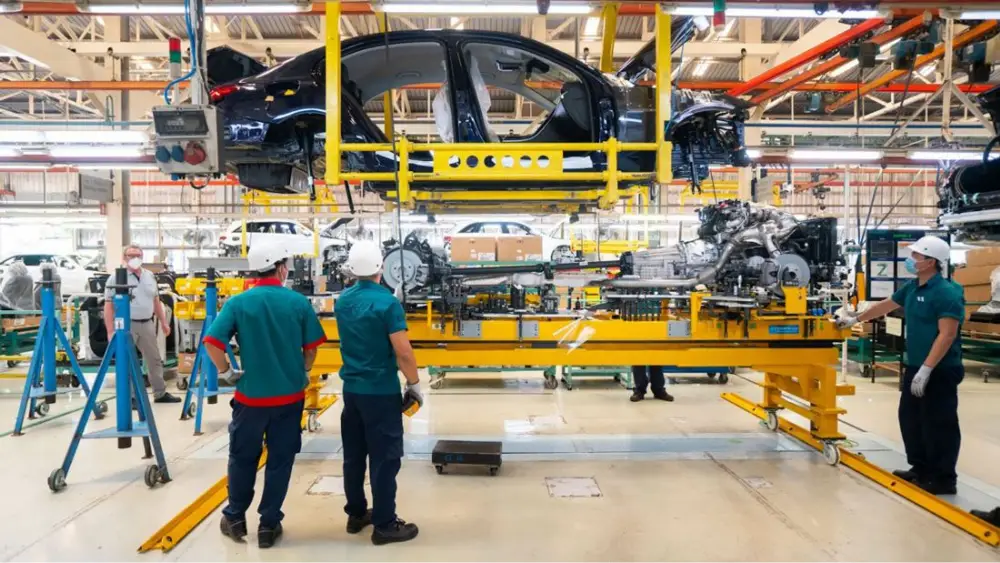
Illustration Photo source: industrial.savills.com.vn
By Nurul Mahfud, S.Tr.Kom
Industrial Digital Transformation Enthusiast
Recent speculation over the possible relocation of two Japanese automotive component factories from East Java to Vietnam has once again sparked concern within Indonesia’s manufacturing sector. Although the government has clarified that no official decision has been made, the issue should not be dismissed lightly. Rather than focusing solely on whether the relocation will actually happen, Indonesia should treat the rumor as an early warning of a much larger regional competition: the race to attract global investment.
According to the Asian Development Outlook (ADO) April 2026 published by the Asian Development Bank (ADB), Vietnam attracted an estimated USD 27.6 billion in foreign direct investment (FDI) during 2025. This represents a 9% year-on-year increase and marks the country’s highest FDI realization in the past five years. The achievement reflects Vietnam’s sustained ability to attract investment despite an increasingly uncertain global economic environment.
Vietnam’s success is not simply the result of offering lower production costs. More importantly, it has built a well-structured investment ecosystem that combines industrial parks, regulatory certainty, efficient infrastructure, and strong integration with global trade networks. For international investors, long-term predictability often matters more than short-term cost advantages.
The country’s strategy is relatively straightforward yet highly effective. First, Vietnam offers competitive fiscal incentives, including generous tax holidays and favorable corporate tax rates in industrial zones. Second, it has developed integrated special economic zones connected directly to ports and export logistics infrastructure. Third, its geopolitical position has made Vietnam one of the biggest beneficiaries of the global “China Plus One” strategy, as multinational corporations diversify their supply chains beyond China. The presence of global manufacturers such as Samsung and Intel has also created a multiplier effect, attracting suppliers and strengthening the country’s industrial ecosystem.
Labor costs remain another important factor influencing investment decisions. Various industry comparisons estimate that manufacturing workers in Vietnam earn approximately USD 250–300 per month, equivalent to around IDR 4–5 million. In contrast, manufacturing wages in Indonesia’s major industrial centers—including Batam, Bekasi, Karawang, and Tangerang—generally range between IDR 4.9 million and IDR 6 million per month.
While the difference may appear modest at the individual level, it becomes highly significant when multiplied across thousands of workers. For labor-intensive industries such as automotive components, where profit margins are often thin, labor costs can substantially influence decisions regarding production locations.
Nevertheless, Indonesia is far from losing the competition. The country continues to possess several structural advantages, including one of Southeast Asia’s largest domestic markets, abundant natural resources, and a strategic position along major international shipping routes. The greater challenge lies not in competing solely on wages, but in maintaining consistent structural reforms, ensuring regulatory certainty, streamlining business licensing, and improving overall production efficiency.
To strengthen Indonesia’s competitiveness, the government has continued promoting Special Economic Zones (SEZs) as new engines of investment-led growth. Among them, the Riau Islands deserve particular attention due to their strategic location near Singapore and major international trade routes, positioning the province as a potential export-oriented manufacturing and logistics hub.
During several press briefings on the government’s second-quarter and second-half 2026 economic stimulus programs, policymakers reaffirmed that accelerating investment in SEZs and industrial estates would remain a key driver of economic growth. The government’s priority is to create a more competitive investment climate through stronger fiscal incentives, faster licensing procedures, and better logistics integration.
Ultimately, the competition between Indonesia and Vietnam extends far beyond lower wages or tax incentives. The real contest is about which country can provide greater long-term certainty for global investors. Vietnam has moved quickly with a systematic and consistent strategy. Indonesia still possesses considerable economic potential, but sustaining policy consistency will be crucial to ensuring the country remains competitive in an increasingly dynamic global industrial landscape.
Whether or not the factory relocation from East Java eventually materializes, the issue should already be viewed as a valuable wake-up call. In today’s fast-moving global economy, investment does not wait. Capital naturally flows toward destinations that are better prepared, more predictable, and more competitive.




















Comment